- What the plate actually does to your body
- What the evidence says, without the brochure gloss
- The two machines we make
- Your first month, session by session
- What a session feels like, described for the skeptic
- The included bands, and the combined session
- The poster on the wall, and why we print one
- Reading a spec sheet without being played
- Who should not stand on one
- Living with a plate: the practical answers
- The honest verdict
We build two vibration plates, and we are going to open this page the way almost no maker of vibration plates opens anything: with the limits. A vibration plate is not a shortcut around exercise, it does not melt fat on its own, and the research behind whole-body vibration is younger and thinner than the research behind an ordinary brisk walk. What a plate is, honestly described, is a low-impact way to make muscles work harder while you stand, squat or stretch on it, plus a genuinely pleasant recovery tool. That is worth owning for many homes. It is not worth owning on the strength of miracle claims, and you will not find any on this page.
The full picture has four parts: what the platform physically does, what the medical literature does and does not support, how our Classic and Slim machines differ, and a first month of sessions that will not leave you standing on a buzzing plate wondering what you are supposed to be doing.
What the plate actually does to your body
Stand on a vibration platform and the deck moves beneath you in small, fast cycles, our machines run between 5 and 60 cycles per second across 120 speed settings. Each cycle nudges you a few millimeters out of balance, and your muscles catch you, reflexively, dozens of times a second. Multiply tiny corrections by minutes and the muscles of your legs, hips and core log real work while you appear to be simply standing still.
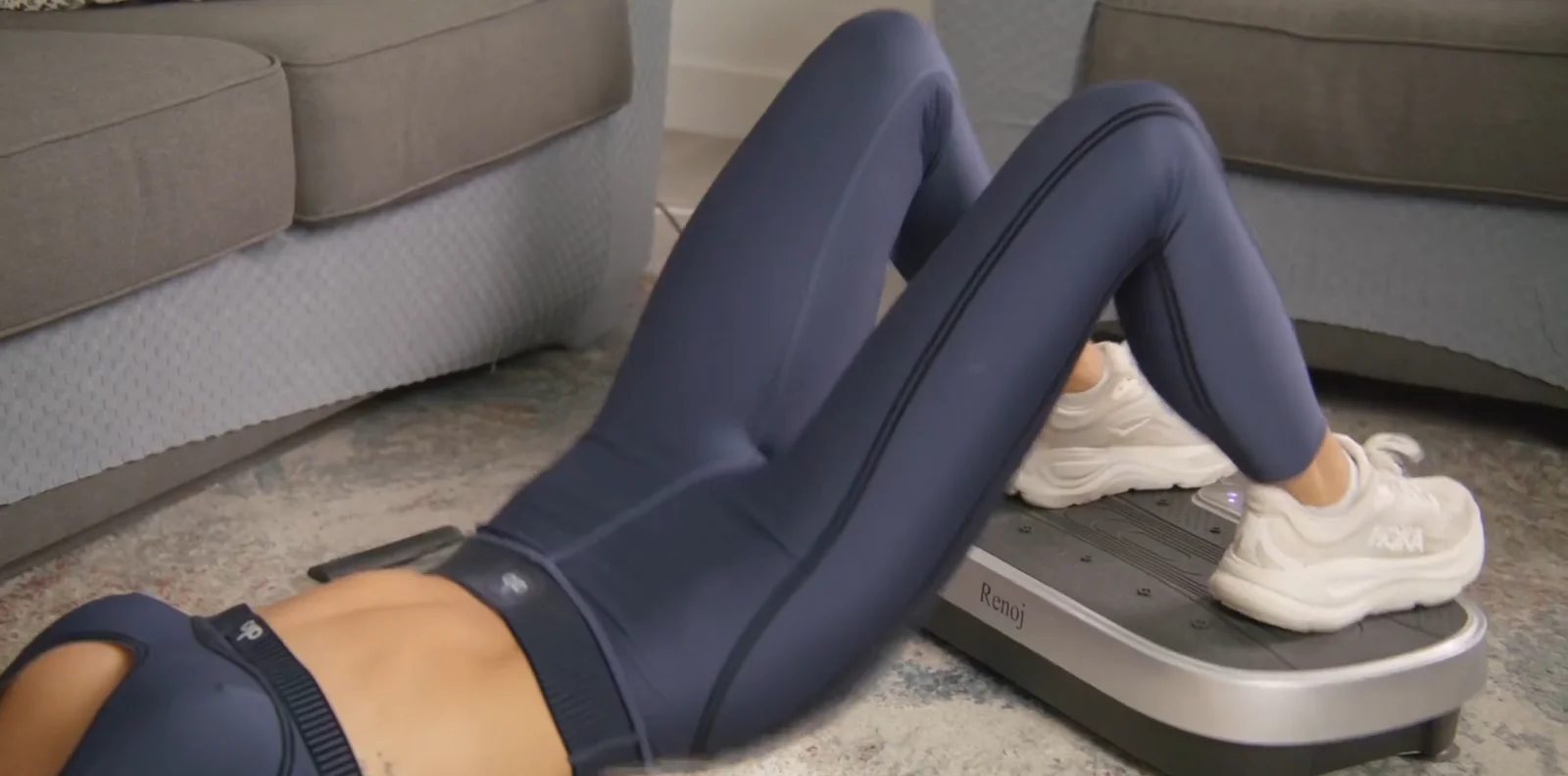
That reflex work is the whole mechanism. It is why a plate session leaves your thighs warm the way a long stair climb does, and why the effect concentrates wherever you place your weight: stand and it loads your legs, plank with forearms on the deck and it loads your shoulders and core, sit with your calves on it after a run and it becomes a massage.
The honest boundary is equally simple. The plate makes positions harder. It does not replace movement. Thirty minutes of standing on vibration will never equal thirty minutes of walking for your heart and lungs, because your heart rate barely rises. The machine belongs in the strength-and-recovery column of your week, not the cardio column.
What the evidence says, without the brochure gloss
We read the medical guidance before writing this page, and we would rather quote it than improve on it. Mayo Clinic's review of whole-body vibration says comprehensive research is still lacking, notes that vibration training may help improve muscle strength, and finds it may help with weight loss, but specifically when you also cut back on calories. Their bottom line is the one we build to: if you want to lose weight and improve fitness, a healthy diet and daily physical activity come first, and vibration does not substitute for them.
Comprehensive research on whole-body vibration is still lacking. It may improve muscle strength, and it may help weight loss when paired with a calorie deficit. It is not a replacement for regular exercise. (Our plain-language summary of the Mayo Clinic guidance linked at the end of this page)
Read our own marketing through that lens. When our product page says the plate supports circulation-style recovery or muscle activation, that is the reflex mechanism above, and it is real. When any product page anywhere, ours included, sits next to the words weight loss, the honest sentence is: the plate can be one part of a routine whose heavy lifting is done by food choices and regular training. The Physical Activity Guidelines still ask for 150 to 300 minutes of moderate aerobic activity a week plus 2 strength days, and a plate changes none of that arithmetic.
The two machines we make
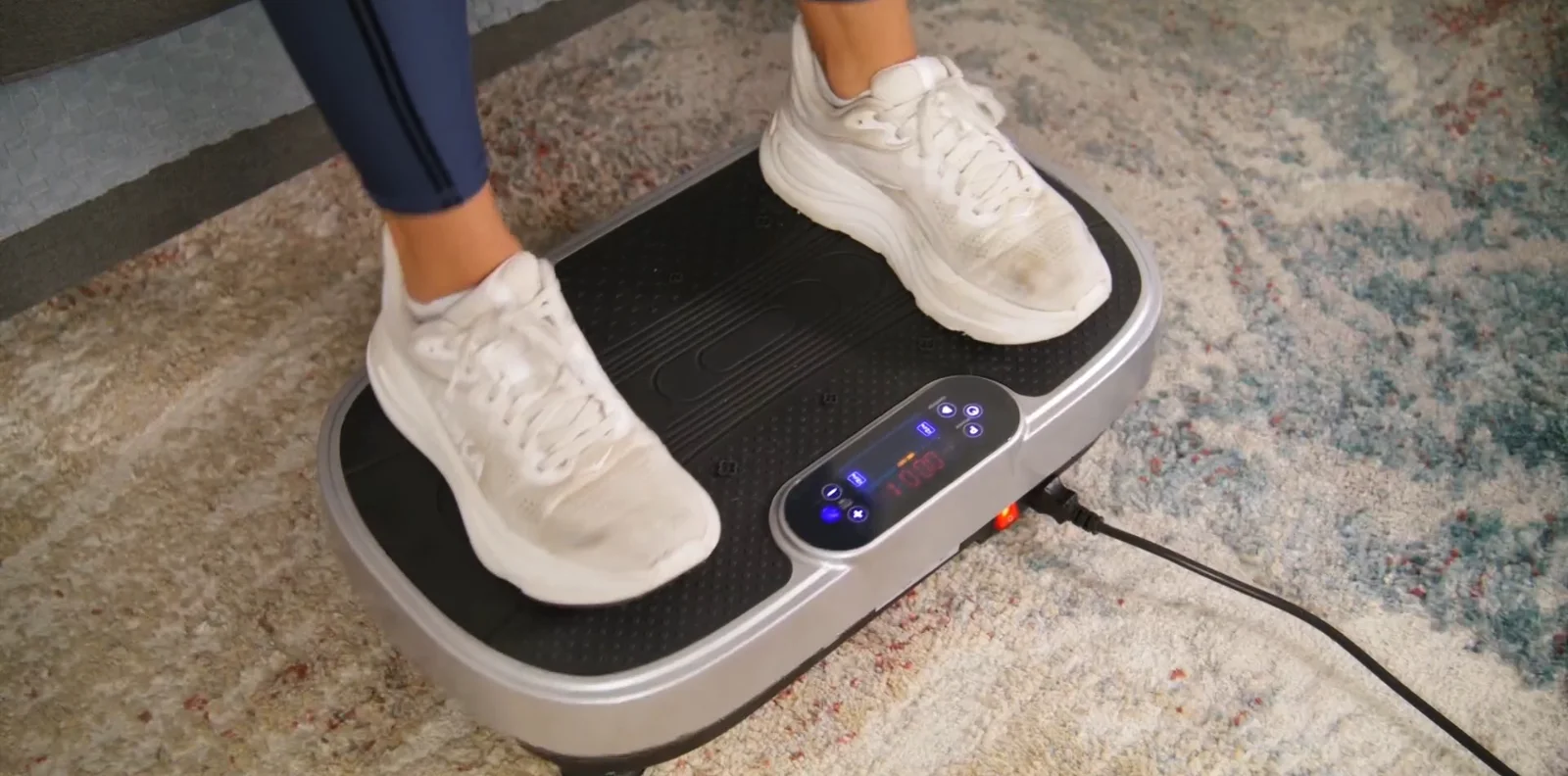
Both of our plates share the same core: a 200-watt motor, 120 speed settings, a remote so you are not bending mid-session, and a pair of clip-on resistance bands that turn standing sessions into upper-body work. The differences are physical, and choosing between them is mostly a question about your floor and your storage.
| Classic | Slim | |
|---|---|---|
| Finish | Silver deck, black platform | Matte black |
| Motor | 200 W | 200 W |
| Speed settings | 120 | 120 |
| Frequency range | 5-60 Hz | 5-60 Hz |
| Rated load | 455 lbs | 450 lbs |
| Machine weight | 18 lbs | 13.7 lbs |
| Footprint | Wider stance deck | 21 x 13.2 x 4.4 inches |
| Noise | Under 50 dB at speed | Quiet · built-in speaker |
| Lives best | In a fixed spot | Under a sofa or desk between uses |
The Classic is the heavier, wider machine. The extra mass is not waste, it is stability, and it is the one we point people toward if the plate will keep a permanent corner of a room and see daily standing work. The Slim is the one that disappears: at 4.4 inches tall and under fourteen pounds it slides beneath the furniture, which for small apartments decides the question by itself. Rated capacity is functionally identical, 455 against 450 pounds, and both far exceed what most households need.
Either way, put the machine on a hard floor or a thin firm mat. Deep carpet swallows the vibration your muscles were supposed to receive, and the suction feet grip hard surfaces best.
Your first month, session by session
The mistake that kills most vibration plates within a month is stepping on at full speed with no plan, feeling silly, and never returning. The machine rewards the opposite: short sessions, low speeds, positions with names. Here is the four-week on-ramp we would hand any beginner. Sessions are ten to fifteen minutes, three days a week, on the days between strength training.
| Week | Speed range | Session |
|---|---|---|
| Week 1 | 1-20 | 2 min standing, knees soft · 1 min rest · 2 min half squat hold · 2 min calves on deck, seated |
| Week 2 | 10-30 | 3 min standing narrow then wide · 2 min half squat · 2 min plank, forearms on deck |
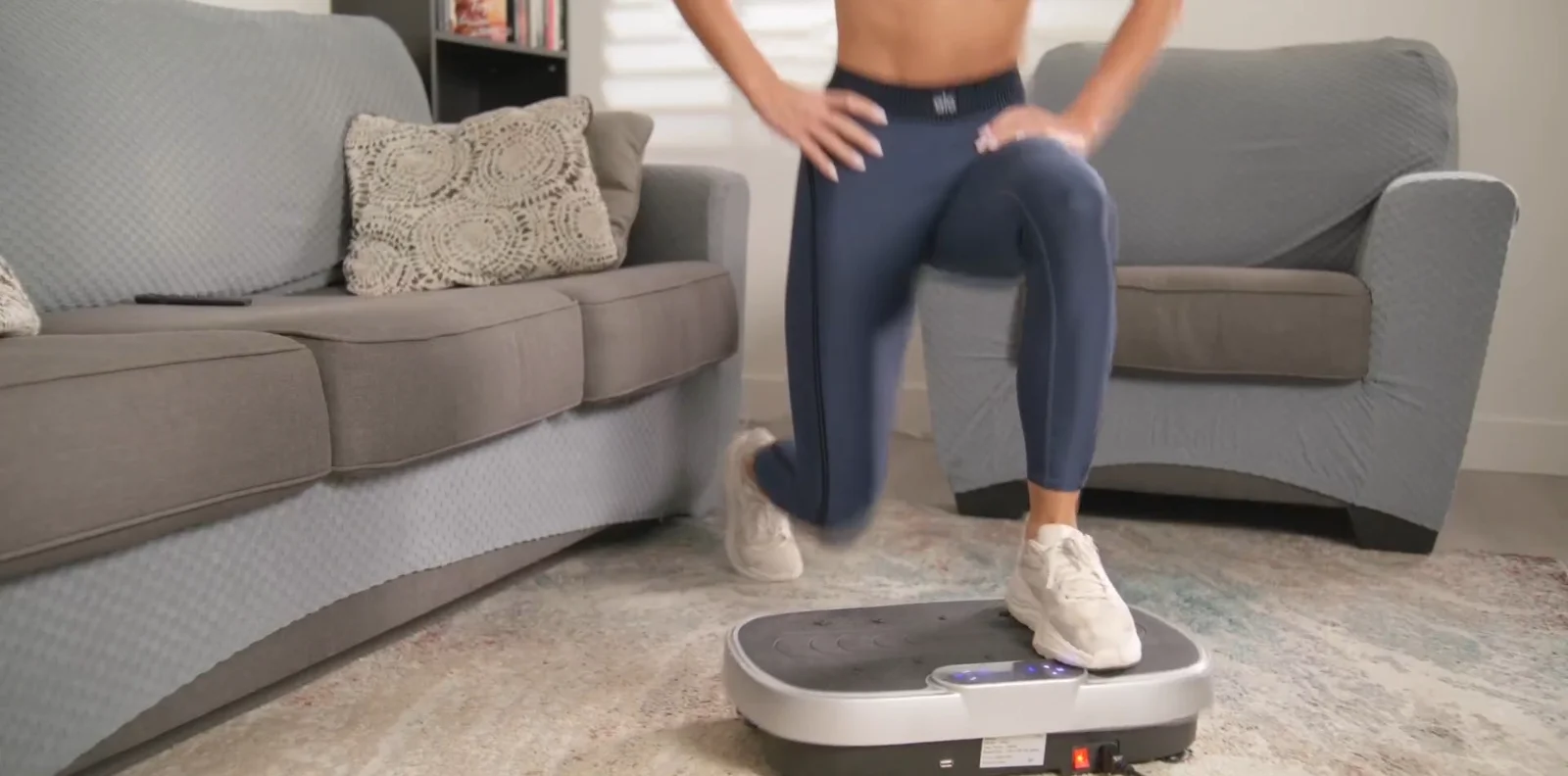
| Week 3 | 20-45 | 3 min squat pulses · 2 min lunge each leg, rear foot on deck · 2 min plank · 2 min seated calves |
| Week 4 | 30-60 | Full circuit twice: squat hold, lunges, push-up hands on deck, plank, standing shake-out |
Two form notes carry all four weeks. Keep your knees unlocked always. Locked knees send vibration to your head instead of your muscles. And treat the speed dial like band levels from our resistance band guide: earn each range by owning the one below it, not by curiosity on day one.
After the month, the plate settles into whatever role your week actually needs. For some owners it stays a training tool, squats and planks at the top half of the dial. For at least as many it becomes the recovery corner: ten minutes of seated calves and hamstrings on a low setting after runs, which is the use our reviews mention most warmly.
What a session feels like, described for the skeptic
Because most people have never stood on one, and because the internet's descriptions swing between infomercial and dismissal, here is the sensory report, plainly. At the bottom of the dial the deck hums. The feeling is closer to standing on a purring appliance than to any exercise. This range is where seated calf work and stretching live, and where the machine earns the recovery half of its reputation: muscles warm, feet wake up, and the sensation is honestly pleasant.
The middle of the dial changes the experience. The hum becomes work you can feel your thighs doing. Hold a half squat at speed 40 and within a minute your legs report something very like the second half of a hill walk, a spreading warmth with a reflexive tremble in it. You are not out of breath, which feels strange at first: the effort is real but it is all local, in the muscle, not in the lungs. This is the range where the strength findings in the research live, and where most training positions belong.
The top third of the dial is specific, not superior. Standing tall there is unpleasant, chattery and pointless. Positions with bent joints and braced cores are what those speeds are for, short squat pulses, planks, push-up holds. If a speed makes your vision buzz or your jaw rattle, you are past the useful range for that position: bend more, or dial down. The best single sentence we can offer a new owner is that the dial selects intensity for a position, not progress through the catalog of speeds. A speed-25 plank outworks a speed-60 stand every day of the week.
First-session expectations, so nothing surprises you: your feet may itch or tingle for a few minutes afterward, which is circulation responding and fades quickly. Your calves will likely be aware of the session the next morning. And the machine will feel loudest the first time simply because it is unfamiliar. By the third session all three impressions shrink to normal.
The included bands, and the combined session
Both machines ship with a pair of clip-on resistance bands, and they are the most under-used item in the box. Clipped to the deck's anchor points, the bands ride the vibration: every curl and row you perform against them happens on top of the platform's constant micro-corrections, so your arms work against elastic tension while your core works against the deck. The result is the closest thing the plate offers to a true full-body session.
The combination we recommend once the four-week ramp is done: stand on the deck at a middle speed, curls for a minute, rows in a hinge for a minute, overhead presses for thirty seconds, then drop the handles and hold the plank. Repeat the circuit three times and the session is a genuine fifteen-minute workout by any honest definition, breath included this time. Owners who outgrow the included pair usually move on to the five-level sets from our band lines, which cover the same movements with finer control over resistance.
The poster on the wall, and why we print one
We sell a companion poster for the plates, a full-body exercise chart with a 3-day split and a 30-day progression plan, and it exists because of everything in the section above. The gap between owning a vibration plate and using one is a plan you can see mid-session, when your phone is across the room and your hands are on the deck. Laminated paper next to the machine closes that gap better than any app we have tried. If you already train with a structured program, you do not need it. If the plate is your first equipment, it is the difference between a machine and a habit.
Reading a spec sheet without being played
The vibration plate market communicates in big numbers, and a buyer's best defense is knowing which numbers move the experience. Frequency range matters most: a machine that genuinely spans 5 to 60 cycles per second covers both the gentle recovery register and the demanding training register, and many budget decks quietly top out far lower than their speed-setting count implies. Speed settings are resolution, not power. 120 settings across a real 5-60 Hz range means fine control, while 120 settings across a narrow range means marketing. Motor wattage predicts consistency under load rather than raw shake: a 200-watt motor holds its programmed frequency when a full-grown adult squats on the deck, where weaker motors sag and buzz.
Rated load deserves one honest note. Our 450 and 455-pound ratings describe the structure, the reinforced ABS shell and the platform, and they leave generous margin for dynamic use, which loads a deck harder than standing does. A rating with margin is what lets a machine hold jump-free but vigorous use for years. What the ratings do not describe is any difference you would feel day to day between our two machines. At every human body weight, both decks behave identically.
The last spec is the one no sheet prints: where the machine will live. A plate you see gets used. A plate in a closet is a purchase, not a habit. That single fact is most of the case for the Slim in small homes, and for the Classic in homes that can give it a permanent corner next to the poster.
Who should not stand on one
This is the section our lawyers did not have to ask for, because the machine itself makes the case. Vibration is a real physical stimulus, and some bodies should not receive it. Skip whole-body vibration, or clear it with your physician first, if you are pregnant, use a pacemaker or implanted device, have had recent surgery, joint replacements, retinal problems, a history of blood clots, or acute back injuries such as a fresh disc problem. Older adults with osteoporosis should ask specifically. Low-speed use is often fine and sometimes encouraged, but that is a call for a doctor who has seen your chart, not for a catalog page.
None of the above is medical advice. It is a maker's honest description of a machine, written next to the public guidance we linked below.
Living with a plate: the practical answers
The questions our support inbox actually receives are less about physiology and more about apartments, so here are the working answers. Noise: under 50 decibels at ordinary speeds, quieter than conversation. Downstairs neighbors hear furniture resonance, not the motor, and a firm mat under the feet removes it. Time of day: any. The sessions are short and the machine wakes nobody. Shoes: barefoot or thin soles indoors, running shoes if the texture bothers your feet. Cleaning: unplug and wipe the deck. Nothing more. Maintenance: none scheduled. If the remote eventually wanders into the same dimension all remotes wander into, we sell a replacement on the accessories shelf of our catalog, along with a spare power cord. The machine outliving its small parts is a feature, and the small parts staying purchasable is our side of it.
Every machine ships with a one-year warranty, and the figures on this page, motor wattage, speed counts, load ratings, come from the same sheet our packing line works from. Prices and stock on the catalog page come from our last update, on the schedule described there.
The honest verdict
Buy a vibration plate if you want a low-impact way to add muscle stimulus to days your joints would rather skip, a recovery ritual that a television pairs with perfectly, and a machine the least athletic person in the household will actually step onto. Do not buy one to outsource weight loss. Mayo Clinic already wrote that conclusion, and we would rather repeat it than meet you in a return process. Pair the plate with two band days from the guide above, walks with a weighted vest on the days between, and the plate stops being a gadget and becomes the quietest working corner of a complete week.
Every product named above, colorways and current prices included, lives on one page of the Renoj band lines, updated on the schedule described on the how-we-update page.
