
- Why loaded walking works
- How heavy: the ten percent rule
- What our vests are made of
- The six-week on-ramp
- Beyond walking: what else the vest loads
- Form under load: the four checkpoints
- Care, washing and how long a vest lasts
- Questions from the inbox
- Who should skip the vest, and the fine print that matters
- Drink like you are carrying weight, because you are
- The complete loaded week
The most repeatable workout in the world is the one you already do: walking. It needs no floor space, no learning curve and no motivation speech, which is exactly why it is the habit most worth upgrading. A weighted vest is the cleanest upgrade there is. It makes every step cost a little more, it changes nothing about your schedule, and unlike hand weights or a loaded backpack it leaves your arms free and your posture untouched. We build a line of fixed-weight vests from 10 to 16 pounds, and using one well comes down to a few decisions: how heavy to start, how to progress, what the health guidance actually supports, and the mistakes that turn a good tool into a sore neck.
Why loaded walking works
Add weight to your frame and every system involved in carrying you must do more work per step. Muscles in your legs, hips and trunk contract harder. Bones receive more loading signal, which is the stimulus that tells them to maintain density. Your heart moves more blood for the same route, and your lungs follow. Harvard Health's review of weighted vest walking lists the benefits in exactly these terms: building muscle strength and bone density, improving the heart's pumping ability, expanding lung capacity, burning more calories, and enhancing core strength.
The same physiology explains why the vest beats the obvious alternatives. Dumbbells carried in hands change your arm swing and grip long before they meaningfully load your legs. A loaded backpack hangs everything on the back of your shoulders and pulls you into a forward lean. A vest wraps the load around your torso, close to your center of gravity, so your gait stays your gait, just more expensive per step.
Rucking, walking with weight, builds muscle strength and bone density, improves the heart's pumping ability, expands lung capacity, burns more calories and enhances core strength. (Our summary of the Harvard Health article linked at the end of this page)
There is also the arithmetic of guidelines. Adults need 150 to 300 minutes of moderate activity a week under the Physical Activity Guidelines, plus 2 muscle-strengthening days. A brisk unweighted walk sits at the easy end of moderate. Put on a vest and the same walk moves decisively into the middle of the range, and steep-hill vest walking starts to knock on the strength door too. Same minutes, more credit.
How heavy: the ten percent rule
The guidance here is unusually unanimous. Harvard Health suggests keeping a vest to about 10 percent of your body weight, at least to start. Our line is built directly around that rule. Each vest is one fixed weight, chosen at purchase, so the table below is the actual buying decision.
| Your body weight | 10% starting vest | Our vest for the job |
|---|---|---|
| Around 100 lbs | 10 lbs | Weighted Vest, 10 lb |
| Around 110 lbs | 11 lbs | Weighted Vest, 11 lb |
| Around 120 lbs | 12 lbs | Weighted Vest, 12 lb |
| Around 140 lbs | 14 lbs | Weighted Vest, 14 lb |
| Around 160 lbs and up | 16 lbs | Weighted Vest, 16 lb |
Two honest notes on the table. If you sit between rows, round down, exactly as with band levels. A vest you forget you are wearing by minute ten is sized right, and a vest you are conscious of in your shoulders by minute five is not. And if you weigh well past 160 pounds, our 16-pound vest lands under the 10 percent line, which for a first vest is a feature: everything in the research happens comfortably below that ceiling, and durability of the habit matters more than the size of the number.
Why fixed weight at all, when adjustable vests exist? Because the plates and pockets of adjustable designs are exactly the parts that rattle, shift and dig. A fixed vest is a sealed system: thousands of fine iron pellets locked in stitched sections, so the mass cannot migrate and nothing hits your spine when you jog a crosswalk. Simplicity is the comfort strategy, not a cost cut.
What our vests are made of
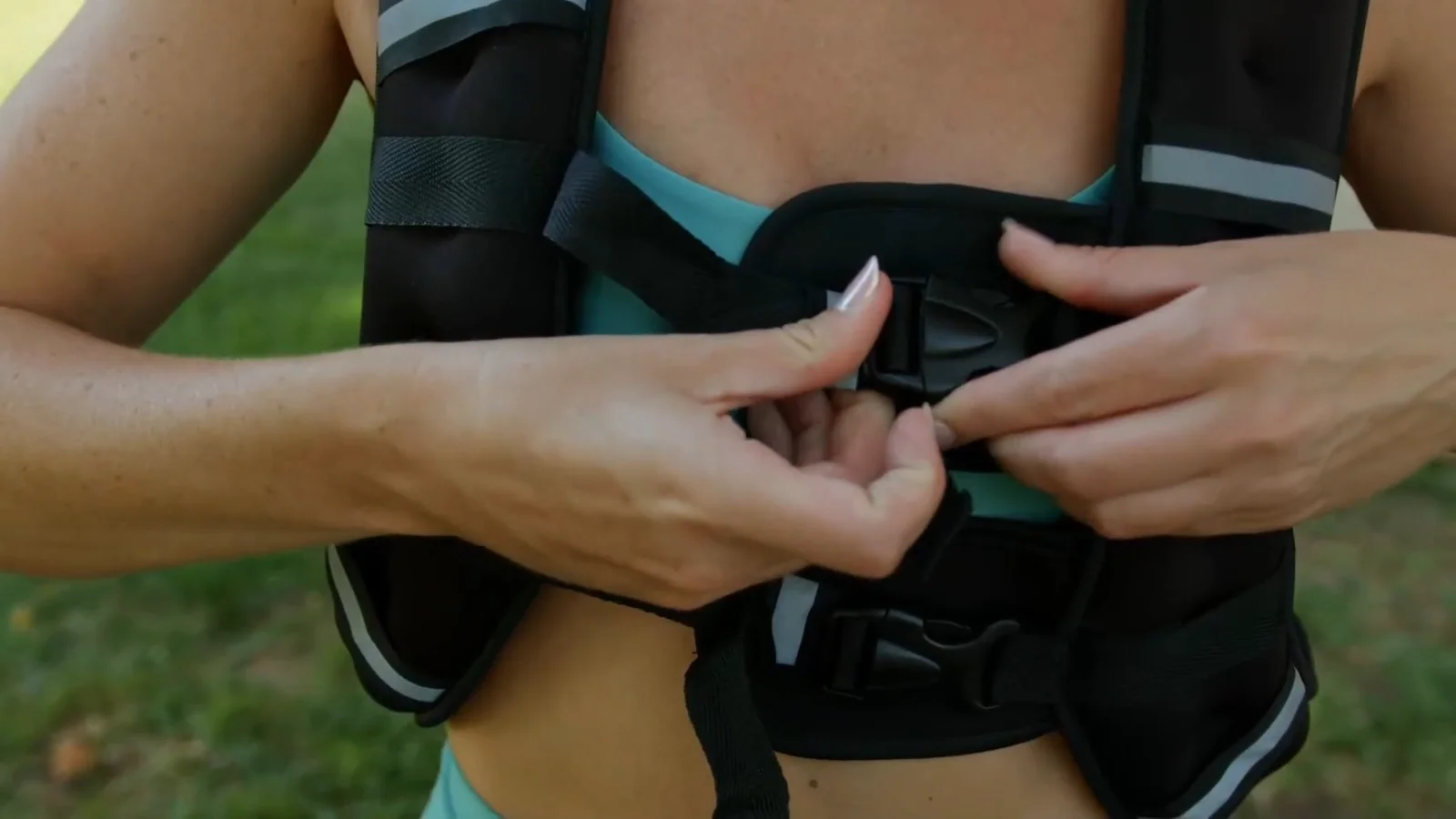
A vest you will wear for an hour has to solve a clothing problem before it solves a fitness problem. Ours are built from a sweat-resistant neoprene shell with breathable mesh against the body, filled with high-density fine iron shot distributed through separately stitched sections, so the weight reads as a uniform layer rather than a set of lumps. The cut is a racerback with a reinforced chest closure, engineered to minimize shifting during higher-intensity movement, and the 16-pound model adds reflective striping for road walkers in the early dark. There is a zippered pouch sized for a phone and keys, which sounds trivial until your third walk, when it becomes the reason the vest replaced your jacket.
One reviewer's summary matches the sheet we build to:
Quality item, sturdy, well made, strong stitching, the removable phone holder is useful. In terms of comfort, it is not like you can forget it is there, but it distributes weight evenly and does not dig in. (oceans13, review of the 16 lb vest)
Fit it snug. A vest worn loose swings, and a swinging load doubles its own cost in the wrong places. Cinch the closure until the vest moves with your ribcage, then forget about it.

The six-week on-ramp
The vest's biggest risk is enthusiasm: it feels easy on day one, so people wear it everywhere immediately, and their calves and shoulders file complaints by day four. Load needs the same gradual introduction any new training stress needs. Here is the ramp we recommend, built on your existing walking habit.
| Week | Vest time | The rest of the walk |
|---|---|---|
| Week 1 | 10 minutes of your usual walk | Unweighted |
| Week 2 | 15-20 minutes | Unweighted |
| Week 3 | 25-30 minutes, flat routes | Unweighted |
| Week 4 | 30-40 minutes, add gentle hills | As you like |
| Week 5 | Most of the walk, one rest day between vest days | Optional |
| Week 6 | Full walks, 3-5 days a week | Habit formed |
The rule underneath the table: the vest goes on for part of the walk, then comes off, and the walk continues. That single habit, vest time inside a longer walk, is what lets the tissues that adapt slowly, feet, shins, lower back, catch up with the heart and lungs that adapt fast. If anything aches in a joint rather than a muscle, drop back a week. The schedule has no prize for finishing early.
Once the six weeks are done, progression looks like walking's version of the band ladder from our resistance band guide: add minutes first, then hills, then pace, and only then consider a heavier vest. Many walkers never need one. A 12-pound vest on a hilly hour is honest training by any measure.
Beyond walking: what else the vest loads
The vest's second life begins the day you notice it works under any bodyweight exercise. Squats, lunges, push-ups, step-ups, planks: each becomes measurably harder with a uniform extra layer, no grip involved. Wear it for the Day 1 lower-body session from our band guide and the hip-band squats gain a plate's worth of honesty. Wear it while doing chores or yard work and ordinary movement quietly counts for more, which is the oldest trick in physical culture wearing a modern shell.
Hikers were the first customers to teach us this line's range. A vest under a daypack pre-loads training for backpacking season without the bulk, and one of the most-liked reviews in our catalog is exactly that story:
I bought this vest to add more intensity to my hiking days, and I am really happy with it. It is very comfortable to wear and definitely makes my hikes more challenging in a good way. (Norma Montes, review of the 12 lb vest)
The one activity we deliberately do not pitch is running. Our own reviewers are candid that a fixed vest is happiest at walking and light jogging paces, and the sports medicine consensus agrees that running under load is an advanced stress. If you run, earn it: months of vest walking first, the lightest vest second.
Form under load: the four checkpoints
An unweighted walk forgives sloppy posture. A loaded one keeps score. Four checkpoints, run once every ten minutes or so, keep the score in your favor.
Head first. The vest's most common side effect is a slow forward drift of the head and shoulders as the miles accumulate, and a forward head multiplies the load your neck carries. The cue that fixes it costs nothing: eyes on the horizon, not the sidewalk, and imagine the crown of your head being pulled gently upward. Second, shoulders. They should sit back and down, resting on the ribcage, not shrugged toward your ears. If you find them creeping up, exhale fully once and let them fall. Third, stride. Under load the right stride is your normal one or a touch shorter, never longer. Overstriding under weight sends impact up the shins and into the knees. Cadence can rise, stride length should not. Fourth, breath. You should be able to speak a full sentence at your working pace. If you cannot, the hill plus the vest has pushed you past moderate, which is fine briefly and on purpose, and worth dialing back when it happens by accident.
The checkpoints matter double on descents. Downhill walking loads knees more than any flat mile, and the vest raises that bill. Shorten your steps going down, keep your torso tall rather than leaning back, and treat steep descents as the technical part of the route, because with weight aboard they are.
Care, washing and how long a vest lasts
The vest is the rare piece of training gear that touches sweat for an hour at a time, so care is mostly hygiene. After sweaty walks, hang it to air-dry on a wide hanger. Do not leave it compressed in a gym bag, which is how neoprene learns to smell permanent. For actual cleaning, wipe the shell with a damp cloth and mild soap, then air-dry away from direct sun. Never machine-wash or submerge a fixed-weight vest: the filling is iron shot, water that reaches it stays, and a soaked vest dries slowly and unevenly. Sun and radiators age the neoprene the same way they age band latex, so the vest stores where the bands store, indoors, dry, out of the light.
Lifespan questions come down to stitching, and it is why ours is double-stitched at the seams that carry the load. Inspect two spots occasionally: the shoulder seams and the chest closure. A vest with intact seams and a working closure is a vest with years left. The pellets themselves do not wear out. If a seam ever frays ahead of its time, that is what the warranty and the contact page are for, and a photograph of the seam speeds everything up.
Questions from the inbox
A few questions arrive at our contact address often enough to earn a public answer. Can two people share one vest? Mechanically yes, and the closure adjusts across a wide range of torsos. The catch is the ten percent rule, since a vest sized for a 160-pound walker is oversized for a 110-pound one. Households that walk together usually end up with two weights, which is also the honest reason our line is priced the way it is. Does the vest work on a treadmill? Perfectly, and incline treadmill walking under a vest is the closest indoor stand-in for hill training we know. Is it normal to feel it in the shoulders early on? For the first minutes of the first weeks, yes, mildly. Snug the closure and let the trapezius adapt. Aches that persist past the session or live in a joint are the signal to drop back a week, not push through. And the question behind many orders: will walking with a vest bulk anyone up? No. It nudges strength, bone and calorie cost in the right direction. It does not and cannot replace dedicated hypertrophy training, and nobody has ever accidentally become bulky on a sidewalk.
Who should skip the vest, and the fine print that matters
Harvard Health's caution list is short and worth taking literally: skip weighted vests if you have neck or back pain, and during pregnancy, and remember that any added load can strain joints and muscles if it arrives faster than the body adapts. We would add, from the support inbox: if you have osteoporosis, balance problems, or a cardiac condition, the vest conversation belongs in your doctor's office before it belongs in a cart. Loaded walking raises the stakes of a stumble, and medical clearance is cheap.
Nothing on this page is medical advice. It is a maker's field guide written alongside the public health sources linked below. Your physician's plan outranks ours.
Drink like you are carrying weight, because you are
A vest walk in summer produces noticeably more sweat than the same route unweighted, and hydration is the recovery variable walkers skip most. The NHS guidance is refreshingly simple: 6 to 8 cups of fluid a day as a baseline, more when you have been sweating from physical activity, and water is the best way to replace what you lose. Practical translation for a vest walker: drink a glass before the walk, carry water on anything past forty minutes, and drink again when you are back.
This is, transparently, also why our catalog contains insulated mugs. The 32 and 40-ounce sizes exist because a morning vest walk and a desk workday can share one vessel of still-cold water, and the leak-proof lids exist because the mug rides in a car cup holder to the trailhead. Catalog logic aside, the advice stands with any cup you own: the vest adds sweat, the water gets it back.
The complete loaded week
Put the pieces above together with the rest of the catalog and a full week assembles itself with almost no scheduling effort. Vest walks carry the daily moderate-activity minutes, three to five of them. Two band sessions carry the strength days the guidelines require. The vibration plate, if one lives in your home, fills the recovery corners, calves and hamstrings on low speed after the longest walk of the week. our vibration plate guide has that routine written out. None of it needs a gym, and all of it survives a busy week, which is the entire philosophy behind Renoj training gear in one sentence.
Prices and stock for every vest weight, current colorways included, live on the catalog page and come from our scheduled update. The how and when of that schedule is written plainly on our how-we-update page.
Every product named above, colorways and current prices included, lives on one page of the Renoj range, updated on the schedule described on the how-we-update page.
